Long before a vessel reaches open water, inspectors, welders, and engineers influence how it will perform under pressure. That responsibility continues shaping the work of the Naval Welding Institute, a Philadelphia-based organization focused on strengthening America’s industrial workforce through advanced manufacturing education, technical training, and workforce development.
When Kristoffer Jones launched the organization in 2019, pressure had already started building across the maritime and defense sectors. Shipbuilding programs expanded while experienced professionals retired across welding, metallurgy, inspection, and manufacturing disciplines. Demand for highly skilled labor accelerated while technical knowledge became increasingly difficult to replace.
“Domestic shipbuilding is in a renaissance period, and it’s a great time to be involved at any level,” he says. “But opportunity only matters if the workforce exists to support it.”
Restoring Specialized Expertise
Time spent inside naval manufacturing environments exposed Kristoffer to the complexity behind modern shipbuilding and industrial production. Work involving advanced alloys, submarine systems, propeller programs, and tightly regulated fabrication processes reinforced how heavily the industry still relies on deeply specialized expertise.
Many of those capabilities develop gradually through direct experience inside fabrication environments where precision affects every stage of production. Welding procedures, materials analysis, nondestructive testing, and inspection standards still depend heavily on knowledge transferred directly between experienced professionals and incoming talent.
“You can’t fast-track mastery in environments where precision matters this much,” he says. “People learn by doing the work beside professionals who understand the standards required.”

Technical training at the institute stays closely connected to the demands of modern naval infrastructure and advanced manufacturing environments. Classroom instruction draws directly from professionals working across industrial production, giving students exposure to the standards, precision, and problem-solving required inside highly specialized fabrication settings.
“We were prepared to share our skillsets with eager learners,” he says. “What we didn’t know was how many lives we would eventually impact through that process.”
Preparation inside the classroom operates alongside practical application, so students enter the workforce with exposure to the standards expected across specialized manufacturing environments. Attention remains fixed on industries where precision influences operational readiness, structural performance, and long-term reliability. Even small inconsistencies can create major consequences later in the production process.
Philadelphia’s Industrial Evolution
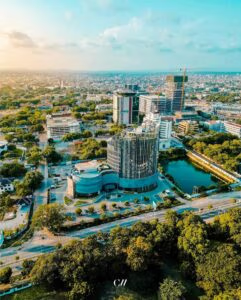
Generations of shipbuilding, naval production, and industrial manufacturing continue influencing Philadelphia’s identity. Activity inside the Navy Yard now reflects another stage in that evolution as advanced manufacturing, engineering, and defense technology increasingly occupy spaces once associated primarily with traditional shipbuilding operations.
The organization operates directly inside that environment, connecting the region’s industrial legacy to workforce demands tied to domestic manufacturing and maritime infrastructure. Across the United States, investment in shipbuilding and industrial production continues increasing pressure on workforce pipelines already struggling to keep pace. Kristoffer believes conversations surrounding manufacturing should extend beyond labor shortages and production targets alone.
“The people learning these trades today become the managers and leaders shaping the industry tomorrow,” he says.
That perspective influences how the organization approaches outreach and accessibility, and students who may never have previously considered careers in manufacturing, engineering, or naval technologies now encounter pathways into industries capable of providing long-term opportunity and upward mobility.
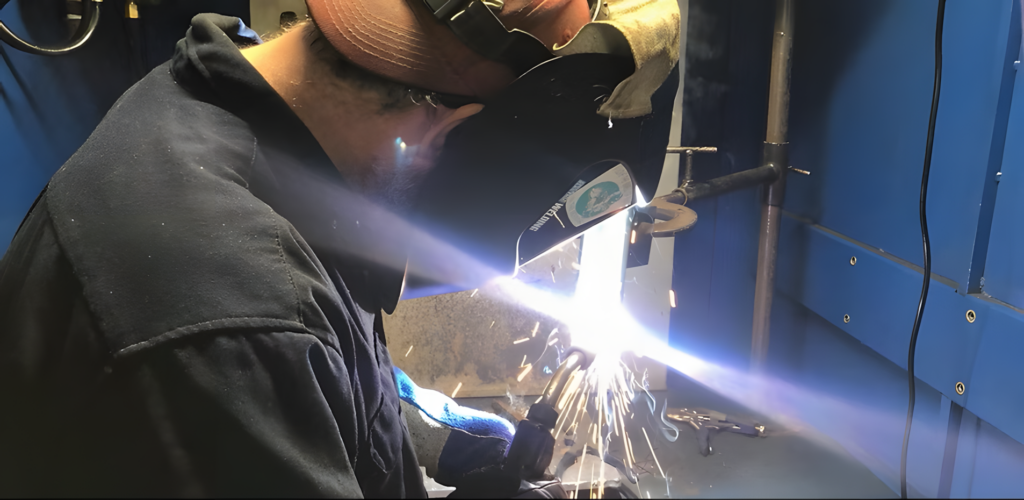
Exposure plays an important role throughout that process. Interaction with professionals who understand both the demands and possibilities attached to industrial careers can reshape how the younger generation views manufacturing and technical trades.
“A lot of young people have never been shown what these industries can offer,” he says. “Once they see the level of innovation involved, the perception changes very quickly. While a lot of us may not come from this industry originally, that doesn’t mean we cannot succeed in it,” he adds. “Sometimes people just need someone willing to show them the path forward.”
Building Long-Term Industrial Capability
Partnerships with colleges, universities, unions, and workforce organizations continue expanding opportunities for students pursuing specialized industrial careers. As demand grows across naval manufacturing and maritime infrastructure, the organization has also started building stronger relationships with regional academic institutions focused on engineering, technical education, and workforce readiness.
Those collaborations are helping introduce naval-focused programs at both the trades and engineering levels, creating earlier pathways into industries that increasingly require specialized technical expertise. By working alongside established colleges and universities, the organization aims to connect classroom education more directly to the realities of modern shipbuilding, advanced manufacturing, and defense production.
“We want students exposed to these opportunities much earlier,” Kristoffer says. “Strong partnerships with colleges and universities allow us to build that bridge between education and the workforce in a much more intentional way.”
Scholarship initiatives have also become part of the organization’s broader mission. The William S. Jones Memorial Scholarship supports students pursuing non-destructive testing education and certification while helping reduce financial barriers that often prevent talented candidates from entering advanced manufacturing fields.
Behind those initiatives sits a long-term view of how industrial innovation actually develops. Technology continues transforming industrial production, but precision manufacturing still depends on experienced professionals capable of solving complex problems in real time. Precision manufacturing still depends on professionals capable of interpreting complex information, solving technical problems, and performing underdemanding conditions.
“Technology will keep evolving,” Kristoffer says. “The need for highly skilled people capable of applying that technology responsibly isn’t going away.”
Another generation of welders, engineers, inspectors, technicians, and specialists is already stepping into those responsibilities across shipyards, fabrication facilities, and manufacturing environments connected to America’s industrial future.
At Naval Welding Institute, that future continues taking shape through education, mentorship, technical training, and expanding academic partnerships grounded in real-world industrial experience.