
For more than 40 years, Laboratory Testing (LTI) has inspected the parts that keep aircraft flying, Navy submarines diving, and defense platforms operational. The work is quiet, exacting, and non-negotiable.
When an aircraft engine spins up at takeoff, or a submarine eases away from a pier on its first underway of a deployment, the margin for error is zero. The parts inside those assemblies have to be certified, traceable, and verified clean of internal defects. That is the work Laboratory Testing, known in the industry as LTI, has been performing since 1984.

Founded more than four decades ago, LTI has grown into one of the country’s trusted independent providers of destructive testing (DT), non-destructive testing (NDT), and precision calibration services. The firm specializes in the kinds of inspections that do not appear in a customer’s product catalog but show up in every certification packet: ultrasonic testing, radiography, magnetic particle, liquid penetrant, eddy current, fatigue, and metallurgical evaluation. If a component is headed into a Mission Critical application, there is a good chance it has crossed an LTI technician’s bench first.
That focus has made LTI a fixture in two of the most demanding sectors in American manufacturing: aerospace and defense. The company maintains OEM approvals from GE Aerospace, Pratt & Whitney, Rolls-Royce, and Boeing, along with ASTM method compliance, ISO/IEC 17025 certification, and Nadcap accreditation. Those approvals are not awarded lightly. They require years of demonstrated process control, auditing, and technician qualification. LTI has built its business around holding them.
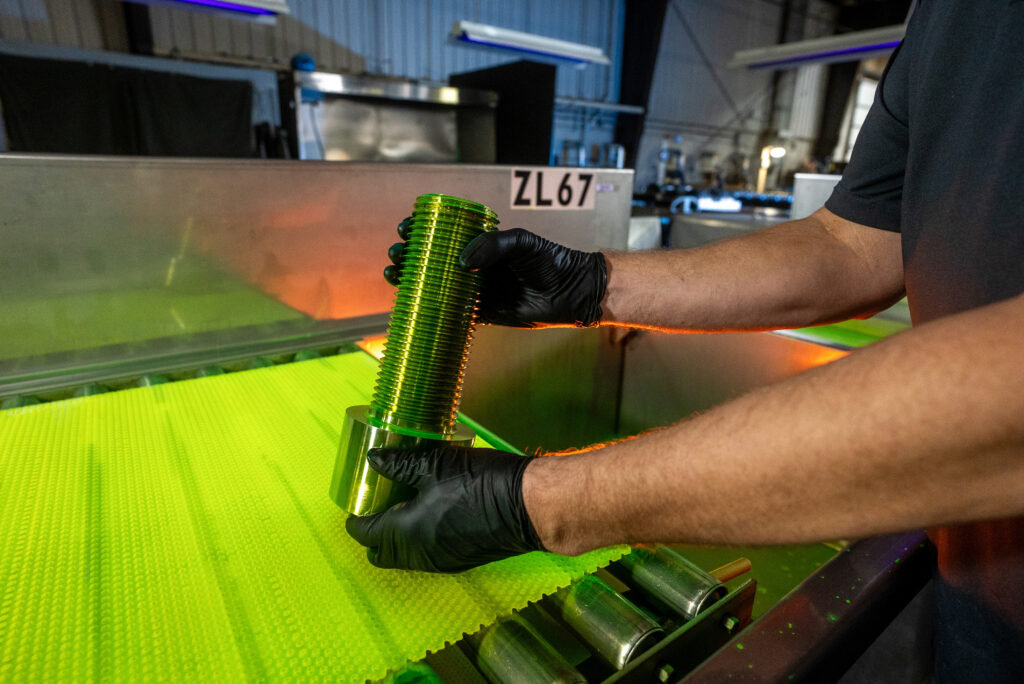
Naval and defense work runs through the entire history of the company. A significant share of LTI’s volume supports the United States Navy, including inspection of components used in submarine programs and surface-fleet construction. From forged shafts and structural forgings to fasteners, fittings, and additively manufactured materials, LTI’s ultrasonic immersion scanning and radiographic services are routinely specified on parts that go to sea with sailors aboard. The company’s technicians are accustomed to cybersecurity requirements, restricted data handling, and the documentation rigor that defense and naval work demands.
“Our job is to find what no one else can. Every part we inspect has a person, or a mission, depending on it.”
– Brandon McVaugh, CEO, Laboratory Testing (LTI) –
Aerospace is the other half of that foundation. Every commercial jet engine contains thousands of parts whose integrity is verified long before assembly. LTI’s immersion scanning bays can resolve defects as small as a No. 1 flat-bottom hole (1/64-inch diameter) at 0.06-inch depth with strong signal-to-noise margins, there solution that modern engine qualification demands. The company inspects billet, bar, forgings, and finished-component geometries across titanium, nickel alloys, steels, and exotic superalloys.

What sets the firm apart is not the equipment alone. It is the discipline of the people operating it. Level III certified technicians, in-house metallurgists, and an accredited calibration laboratory operate as a single integrated workflow under one roof. Customers can ship a part to LTI, have it inspected, measured, and certified, and receive traceable paperwork back within the timelines their programs demand.
LTI’s inclusion in the Philadelphia Navy Yard chapter of INNOVATE is fitting. The region has been a naval and manufacturing hub since the Continental Navy was established in 1775, and the Yard itself has launched, repaired, and refit warships across three centuries. Two hundred and fifty years later, firms like Laboratory Testing carry that tradition forward in a different form, inspecting the parts whose failure would be measured in lives, not line items.

LTI has grown organically into a regional anchor for precision materials testing. Its leadership has prioritized investment in new inspection technology, technician training, and expanded capacity to meet the growing demand for domestic testing services, as aerospace primes, naval programs, and defense contractors work to shorten supply chains and bring qualified work back onshore. Accuracy is what customers pay for. LTI’s reporting workflow is built to keep inspection data traceable and error-free, from sample to certificate.
For LTI, the next decade looks a lot like the last four: more parts, more scrutiny, and higher stakes. The work will stay quiet. The standards will not.