Why the most natural interface we have is finally becoming the way we get work done
For 40 years, getting something out of your head and into a computer has meant the same thing: stop, find a keyboard, and type. We have accepted this as normal. But typing is a workaround, not a natural act. The most fluent interface a human owns is the one we are born with and use thousands of times a day without a single lesson. We talk.
In 2026, that obvious fact is quietly reshaping productivity software. After years of voice being stuck in the novelty drawer of “set a timer” and “what’s the weather,” a wave of products is now treating speech as the primary way to create, not just command. And the difference between those two ideas is bigger than it sounds.
From voice commands to voice creation
The first era of voice tech was about commands. You said a fixed phrase, a device did one fixed thing. Useful, but shallow. It never touched the real work, which is messy, unstructured thinking that needs to be captured before it evaporates.
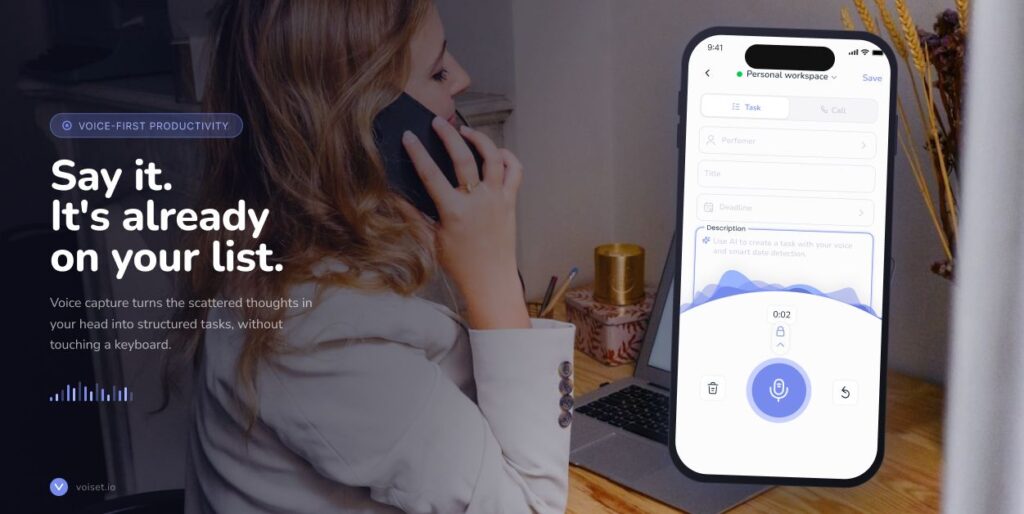
The shift happening now is from command to creation. Modern speech models are accurate enough, and language models capable enough, that you can simply talk the way you think, and software turns the mess into structure. You say, “remind me to send the contract to Maria on Thursday and follow up if she hasn’t replied by Monday,” and instead of a transcript, you get two scheduled tasks with the right dates. The machine does the formatting. You just speak.
This is the new ability. Dictation gives you text. Voice creation gives you organized action. One saves you a few keystrokes; the other removes an entire step from how work gets done.
Why this matters more than it seems
Most people speak around 150 words a minute and type barely a third of that, but speed is the least interesting part of this.
Every productivity tool ever built dies at the same point: the moment of capture. A thought arrives while you are walking, driving, or moving between places, and by the time you could open an app and type it, the thought is gone. The note never makes it into your planner. The task never reaches your list.
Voice input closes that gap to almost zero. You speak the moment the thought appears, hands free, eyes elsewhere. For anyone whose day does not happen at a desk, a real-estate agent between showings, a contractor up a ladder, a parent with no free hands, this is not a convenience. It is the difference between a system that gets used and one that gets abandoned in week two.
It matters even more for people whose brains resist the typing-and-organizing ritual altogether. For adults with ADHD, for instance, the hardest part of any task is starting, and a tool that asks for ten taps before a thought is saved simply will not be used. Lowering capture to a single spoken sentence is not a nice-to-have for them. It is what makes a planner work at all.
This is the bet behind a small group of voice-first tools now reaching the market. A voice-first task planner like Voiset, for example, was built around spoken capture from the ground up rather than bolting a microphone onto a typed app, supporting more than fifty languages so the spoken sentence does not have to be in English to become a structured task. The design choice is the whole point: when the fastest path in is also the most natural one, the tool stops competing for your attention and starts disappearing into the day.
The next step: software that listens inside your other tools
There is a second shift arriving close behind the first, and it is easy to miss. Until recently, a voice-first app was still an island. You spoke into it, it organized your tasks, and that was the boundary. To do anything with the rest of your work you still had to switch windows, copy things across, and stitch the pieces together by hand.
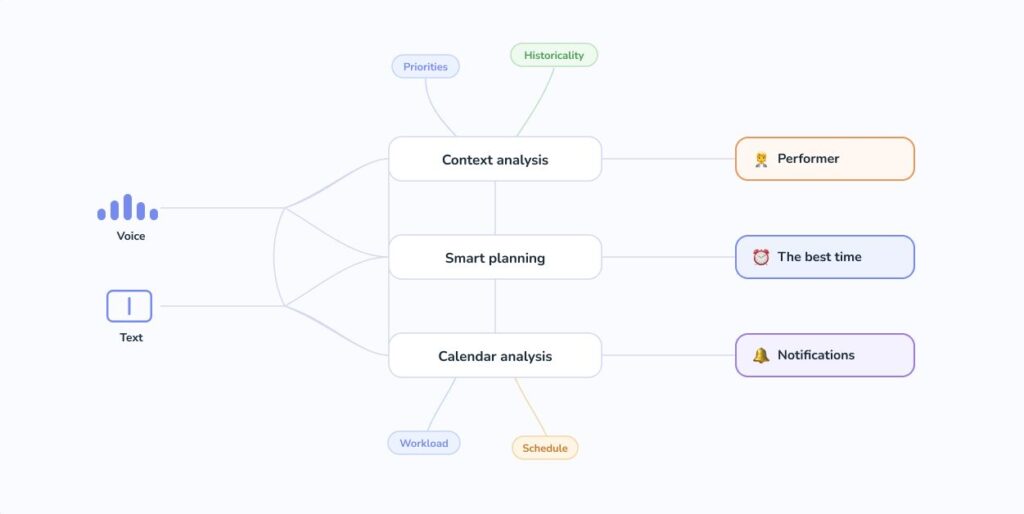
That boundary is dissolving. With open standards like the Model Context Protocol, an AI assistant can now reach directly into the tools you already use and act on your behalf. Instead of opening a planner to move a deadline, you tell the assistant, in plain language, to move it, and it happens in the underlying app, against your real data. The conversation becomes the interface. Voiset, for instance, lets you connect a task manager to Claude, so planning a week of work is a sentence rather than a session of clicking. Speech goes in at one end, organized action comes out the other, and the app itself fades into the background where good infrastructure belongs.
A return, not an invention
It is tempting to frame all of this as something new. It is closer to a return. For most of human history, the way we passed on knowledge, made plans, and got others to act was by speaking. The keyboard was a forty-year detour, a brilliant one, but a detour all the same. What is happening now is that the machine is finally catching up to us, instead of the other way around.
The companies that understand this are not adding a voice feature. They are rethinking what the first interaction with software should feel like. And the answer they are arriving at is the oldest one there is: you open your mouth, you say what you need, and the work begins. Modern technology can already take the keyboard out of the loop and let us work by voice.