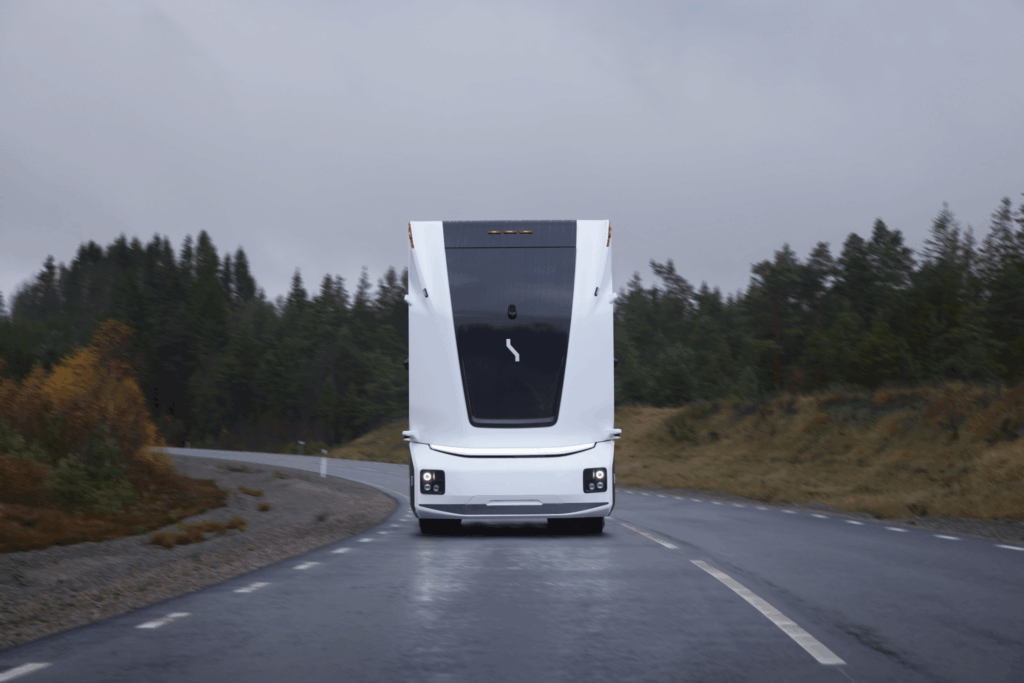

The road freight industry stands at a defining moment. Once constrained by the limits of diesel and incremental change, the $4.6 trillion global market is now poised for disruption at unprecedented scale. The catalyst is clear: artificial intelligence is rapidly redrawing the boundaries of what is possible in logistics, and those who harness it will shape the next era of freight.
Every major technological shift begins the same way, with a hypothesis. A belief that a better system is possible, even before the proof exists. In road freight, that belief is now backed by hard evidence. A decade ago, the idea of a fully electric, cost-competitive freight network seemed remote. Yet by 2025, progress in unit economics, regulatory readiness and customer demand for sustainable operations has brought the sector to an inflection point.
But one critical question has lingered: should the industry simply swap diesel trucks for electric ones, or reimagine the system from the ground up?
The answer is becoming clearer. Global road freight already accounts for 8% of CO2 emissions, a figure that could surpass 10% by 2030. Electric operations can cut operational emissions by up to 95%, yet the traditional one-to-one replacement model breaks down at scale. Range constraints, charging dynamics and operational uncertainty compound when applied across an entire fleet. What’s needed is not just cleaner hardware, it is intelligent, system-level transformation.
This is where AI enters as the missing link. New research by Einride and Fraunhofer ISI, analyzing more than 38,000 real-world shipments, demonstrates the magnitude of impact. When fleets are replanned using AI and dynamically optimizing routes, vehicle roles and charging, electric trucks can shoulder 85% of total payload, compared to 57% under one-to-one replacement. Total cost of ownership drops by up to 13% versus diesel, more than four times the improvement seen in hardware-only electrification strategies. And critically, AI planning reduces the need for costly infrastructure by activating intelligence rather than asphalt.
The implications are profound. Scaling electric freight is no longer a technical problem waiting for future breakthroughs. It is an operational challenge solvable today with data, optimization and a willingness to rethink outdated assumptions.
The freight revolution has already begun. Competitive advantage will belong to those who adopt AI-driven planning not as an add-on, but as the operating system of their future fleets. The question is no longer if we transform road freight, but how boldly we choose to lead that transformation.