

Artificial intelligence is moving faster than almost any technology shift before it. Organizations are adopting generative tools at scale, automating workflows, accelerating output, and celebrating efficiency gains. Yet beneath the surface of this rapid adoption, a quieter problem is emerging. As AI becomes more capable and more accessible, ideas are starting to look the same. Hupside exists to confront that problem head-on.
Based in Northern Virginia, Hupside was built around a sharp insight: AI is excellent at predicting what is most likely, but human progress depends on what is most original. As AI systems spread across industries, strategies, messaging, and thinking patterns increasingly converge. Efficiency improves, but differentiation fades. For leaders chasing real transformation, that tradeoff is becoming impossible to ignore.
“AI is an extraordinary accelerator. But acceleration only matters if humans are deciding where to go. Otherwise, everyone just gets to the same place faster.”
– Jonathan Aberman, Co-Founder & CEO –
From AI Adoption to Human Capability
Hupside’s founding team came to AI from markedly different paths. Jonathan brings decades of experience as an entrepreneur, investor, and ecosystem builder. Co-founder Erich Baumgartner adds deep operating expertise from scaling enterprise technology companies. Cognitive scientists Adam Green and Dan Johnson contribute years of research focused on how human thinking fundamentally differs from machine processes.
Despite their varied backgrounds, the team kept seeing the same pattern. Organizations were investing heavily in AI, yet struggling to understand where real value was still being created once machines entered the workflow. Human judgment, originality, and insight clearly mattered, but there was no way to see or measure them.

“That blind spot was everywhere. Leaders could see efficiency metrics, usage data, and output volume. What they could not see was who was actually expanding the idea space once AI was involved.”
– Jonathan Aberman, Co-Founder & CEO –
That realization led to the creation of Hupside and the introduction of a new concept the company calls Original Intelligence.
Defining Original Intelligence
Original Intelligence, or OI, is the measurable human ability to generate ideas that fall outside AI’s probabilistic norms. It is not creativity as a vague aspiration or personality trait. It is a behavioral capability that shows up when people reframe problems, connect unexpected ideas, and use AI as an accelerant rather than a substitute. “In an AI-saturated world, efficiency is table stakes,” says Jonathan. “Originality is the advantage.”
To make that advantage visible, Hupside built Hupchecker, the world’s first software platform designed specifically to measure Original Intelligence. The platform compares human responses to both other humans and AI outputs, revealing who consistently goes beyond what machines predict and who stays within those boundaries.
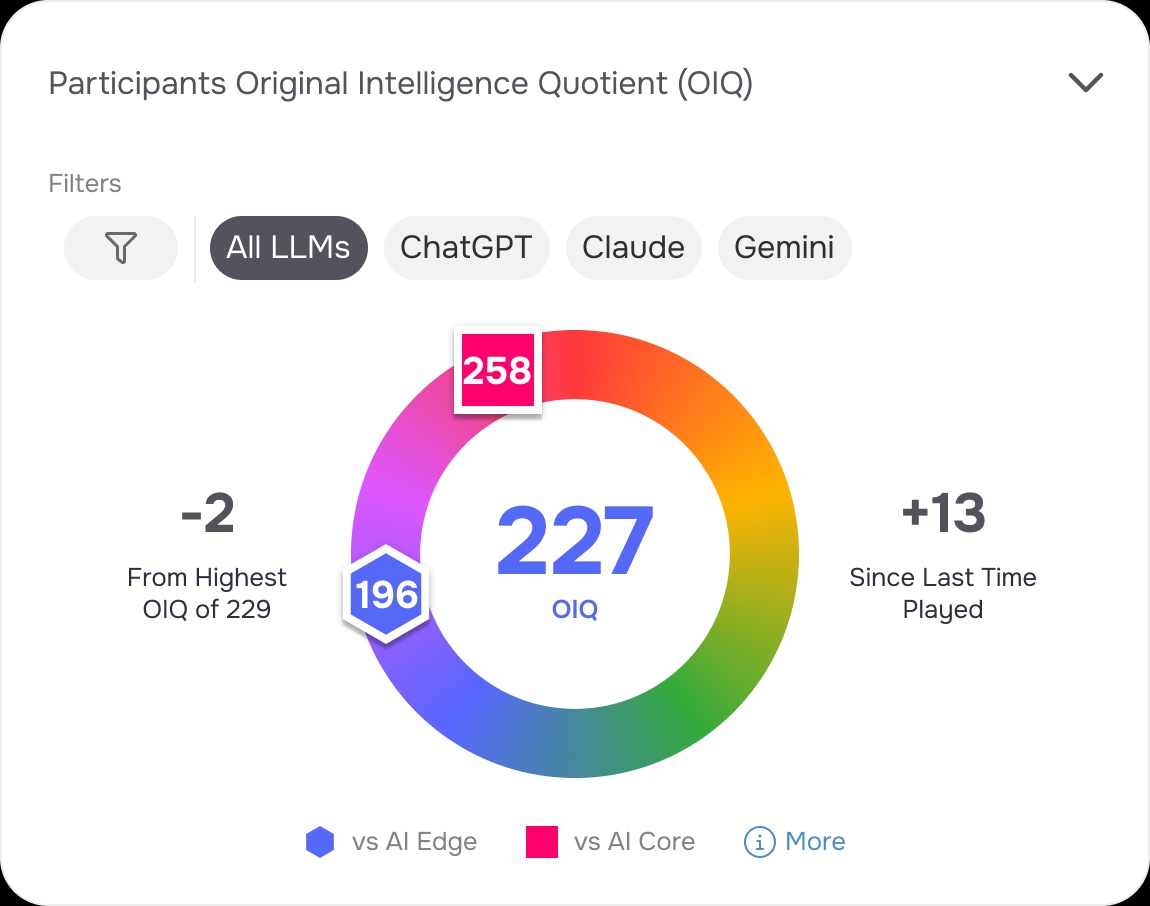
Built on rigorous cognitive science and independent of any AI provider, Hupchecker evolves as models change. That independence allows it to remain relevant as AI capabilities advance, instead of being locked to any single system or approach.
“What we measure is how people think when AI is part of the equation. That is the missing variable in most AI transformation efforts.”
– Jonathan Aberman, Co-Founder & CEO –
Innovation Beyond Efficiency
Hupside’s work reframes how organizations approach AI adoption. Rather than treating AI as a technology rollout, the company positions transformation as a human capability challenge. The central question shifts from which tools to deploy to how people are empowered to think alongside them.
This reframing has resonated across government, industry, and education, where leaders are grappling with declining differentiation despite heavy AI investment. As generative systems become universal, output alone is no longer a competitive signal. Judgment and originality are.
“AI will make everyone faster. The people who create value are the ones who decide what questions to ask and what directions are worth pursuing.”
– Jonathan Aberman, Co-Founder & CEO –
The tipping point for Hupside came as that realization spread. As generative AI reached mainstream adoption, organizations began seeing efficiency gains paired with growing sameness and limited returns. What had been framed as a technology issue revealed itself as a human one. Demand accelerated for a way to identify who could actually create value with AI, not just use it.
A Human-Centered Future for AI
Looking ahead, Hupside is focused on putting humans back at the center of transformation. As AI becomes embedded in nearly every workflow, originality and judgment no longer need to remain abstract or overlooked. Hupside has made them measurable.
That capability allows organizations to see, value, and invest in the people who drive progress, ensuring that AI amplifies human potential rather than replacing it.
Northern Virginia plays a central role in that mission. With deep roots across entrepreneurship, enterprise technology, academia, and government-facing markets, the founding team is actively engaged in the regional innovation ecosystem. Through ongoing work with the Northern Virginia Technology Council (NVTC) and collaboration with founders, universities, and public- and private-sector leaders, Hupside is helping position the region as a leader in human-centered AI innovation.
“Northern Virginia has all the ingredients to shape what comes next. The challenge is not building smarter machines. It’s making sure we are building smarter ways for humans to lead alongside them.”
– Jonathan Aberman, Co-Founder & CEO –
AI is changing how work gets done, but it should not define how value is created. The organizations that succeed will be those that preserve the human capabilities machines cannot replicate. By making originality visible and measurable, Hupside is helping ensure that as AI scales, human innovation does not disappear into the background, but becomes the defining advantage of the AI era.