
Most executives approaching AI are solving the wrong problem.
They want to know which tools to buy, which pilots to run, which consultants to hire. They are asking optimization questions when they face an architecture problem.
I know because 18 months ago, I was asking the same questions. Over 21 years, I had advised more than 40 Fortune 500 companies and spent 14 years as an executive leader running global operations across 18 countries. I was effective by every conventional measure. I was also running into a wall that no amount of optimization could break through.
The complexity moved faster than I could process it. Strategic windows closed before analysis finished. Traditional leadership models — built for stability and hierarchy—were collapsing under conditions that now require speed and synthesis.
So I did something most executives advising on AI transformation will not do: I became the experiment.
I rebuilt my entire operating model around AI augmentation. Not as a side project. As a complete redesign. Today, I operate with more than 20 specialized AI agents that analyze research, build models, and accelerate decision-making across simultaneous C-suite engagements. I am present for my children in Stockholm while running enterprise transformations across three continents.
This did not make me more efficient. It made me strategically nonlinear. More importantly, it made work meaningful again.
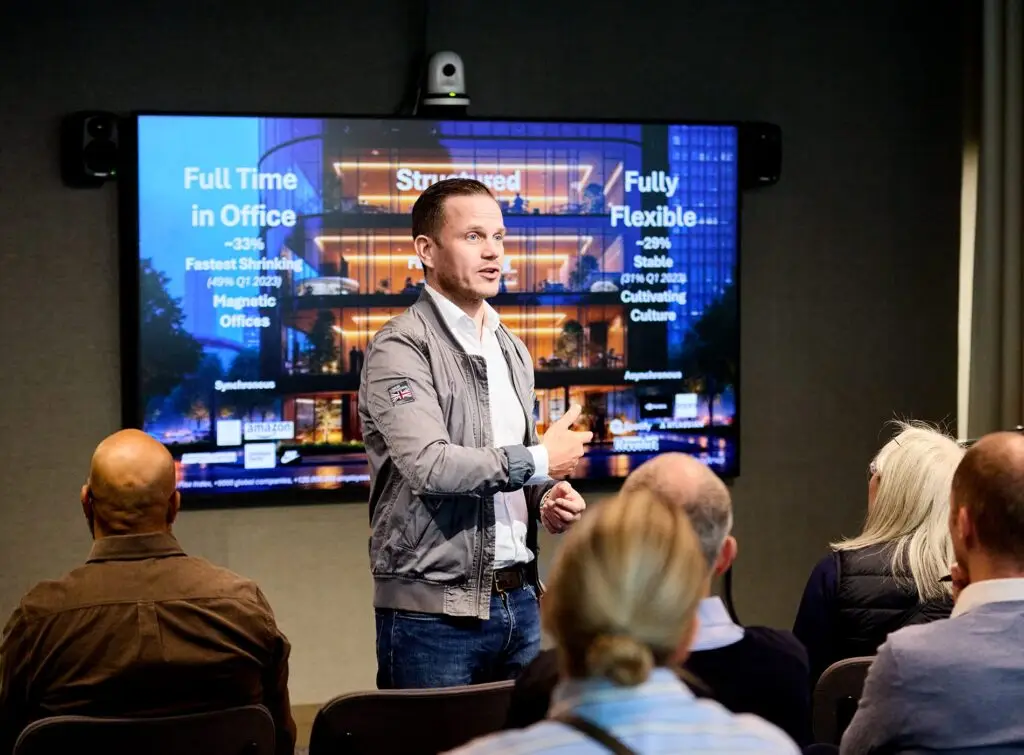
That transformation is why I now lead Europe for Lead With AI—not to deliver training programs, but to guide transformation partnerships that reshape how leaders relate to work itself. Our mission is to make work more meaningful for millions by fundamentally redesigning the relationship between humans and work. I speak at stages from Innovation Pioneers’ Summit to Wallenberg Institute programs. I invest in early-stage AI ventures building the next generation of work infrastructure. Through THE HENRIK, my globally followed editorial for Fortune 500 leaders, I challenge conventional wisdom about AI adoption that continues to fail most enterprises.
Because it is failing. We have data. 88 percent of enterprises report using AI. Only 39 percent show measurable EBIT improvement. That 50-point gap is not a technology problem. It is an architecture problem disguised as a tools problem.
Most AI consultants are optimizing legacy systems. The executives who will define the next decade are redesigning the systems themselves. This requires a different model: what I call the augmented executive. Not a human replaced by AI. Not a human with AI as a productivity add-on. A leader whose operating system is rebuilt around what becomes possible when judgment orchestrates machine capability without bandwidth constraints.
Sweden and broader Europe are uniquely positioned for this shift. Our culture of trust, distributed decision-making, and flat organizational norms have been training us for AI-native structures decades before the technology arrived to enable them.
The transformation is already underway. The only question is whether you are redesigning your operating system or still optimizing the old one.
Over 21 years, Henrik advised 40+ Fortune 500 companies and led global operations for 14 years. Then Henrik became the experiment — rebuilding his own operating system around AI augmentation.