The future of hiring won’t be decided by résumés, but by who can see potential others miss. For decades, employers have relied on job titles, keywords, and pedigree as proxies for capability. Those filters were built for scale, not for insight. In doing so, they’ve excluded qualified people every day.
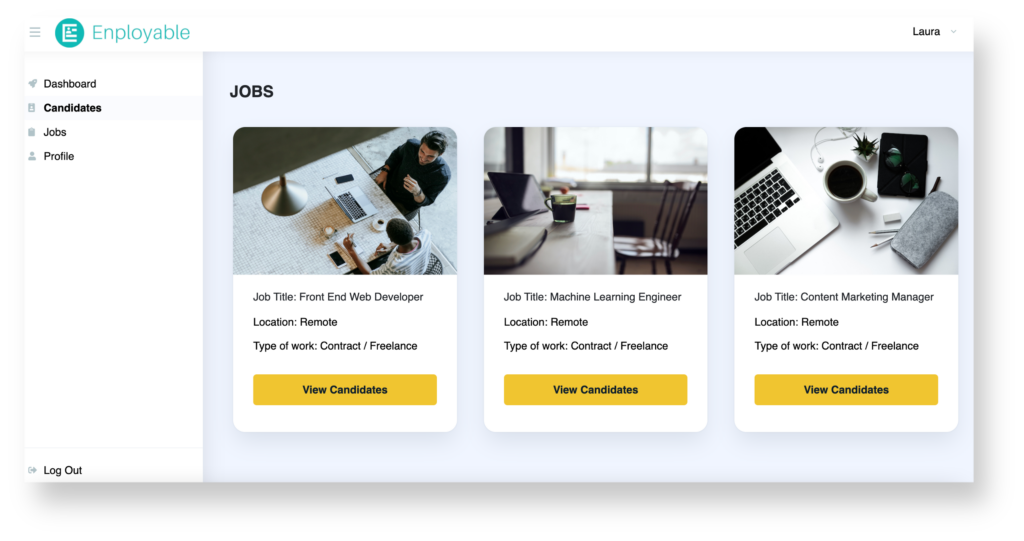
From Tysons, Virginia, Enployable is working to correct that imbalance. The company’s workforce intelligence platform identifies transferable skills across industries, uncovering capabilities that conventional hiring systems routinely overlook. At its core is a simple reframing of the hiring question.
“The most important question in hiring isn’t ‘Where did you work?’” says Founder and CEO Laura Truncellito. “It’s ‘What can you do?’” What limits hiring today isn’t a lack of talent, but the way that talent is evaluated. As automation has increased, hiring infrastructure has become more rigid rather than more perceptive. What’s missing is contextual understanding.
The Founder Insight
The urgency of that gap became clear in 2020. During the pandemic, Laura was leading a government contracting firm focused on natural language processing. As colleagues and peers lost jobs, she began helping them navigate the hiring process. What she encountered wasn’t a lack of talent, but a system misaligned with reality.
“Job boards and résumés weren’t answering the questions that matter,” she says. “What can this person contribute? Where could they thrive?” She had experienced the same frustration as an employer. Résumé filters didn’t reliably identify the work ethic, adaptability, and mindset she valued most in a team. The disconnect between capability and visibility was consistent.
After receiving a scholarship from the Women Tech Network to join the Founder Institute, she began designing a different model. With a machine learning engineering background that included scholarships with Google, Meta, and Intel, along with certifications in artificial intelligence and data science from MIT, she built the foundation for what would become Enployable.
Engineering Workforce Intelligence
The company didn’t simply refine recruiting software but rather created a new category: workforce intelligence. Instead of relying on keyword matches, the platform focuses on how skills move across industries. A welder’s precision can power semiconductor manufacturing. A logistics coordinator’s operational experience can translate into datacenter operations. These transitions happen in practice all the time, yet conventional systems rarely recognize them because they’re built to compare titles rather than understand capability.
“Most hiring tools are built to filter people out,” she says. “We built ours to bring the right people in.” The platform was designed as AI-native from the beginning. Machine learning and natural language processing form its foundation, enabling contextual analysis of skill sets rather than simple text matching. Enployable also developed Evan, its AI hiring agent, which conducts structured candidate interviews, gathers hiring intelligence, and accelerates onboarding within enterprise-grade security frameworks.
Together, the matching engine and AI engagement layer allow companies to expand talent pools three to five times while delivering qualified candidates in as little as 48 hours. Enterprise clients, including Mercedes-Benz and Vanguard Packaging, have seen that impact firsthand.

From Breakthrough to Validation
In 2025, Enployable moved from emerging platform to validated enterprise solution. Acceptance into the NVIDIA Inception program signaled its position among high-growth artificial intelligence companies operating at the frontier of applied AI. Shortly thereafter, the company solved a two-year hiring challenge for Vanguard Packaging in 48 hours.
Each milestone confirmed what had been true all along: the limitation wasn’t capability itself, but the system used to evaluate it. “AI is often framed as something that replaces people,” Laura says. “We’re proving it can elevate them.”
National Impact, Regional Roots
The urgency is already here. Across semiconductors, advanced manufacturing, construction, and data centers, employers are looking for skilled workers faster than conventional hiring systems can supply them. Federal initiatives such as the CHIPS Act have accelerated that pressure. At the same time, most pipelines remain anchored to rigid credentials and linear career paths that no longer match how modern talent develops.
The company’s model opens alternative pathways into these industries, surfacing workers whose capabilities align with emerging roles even if their résumés do not reflect traditional entry points. In doing so, it expands access while strengthening employer resilience. “There’s a massive hidden workforce,” she says. “We discover it.”
The company’s growth is closely tied to Northern Virginia’s innovation landscape. Enployable is an active member of the Northern Virginia Technology Council (NVTC) and a Tech100 honoree. Laura serves on the NVTC AI and Digital Transformation Committee, contributing to dialogue around responsible artificial intelligence adoption. The company also collaborates with Associated Builders and Contractors chapters, IEEE, and the Founder Institute to support workforce development and AI education initiatives. “Innovation grows stronger when it’s shared,” she says. “Northern Virginia has the alignment to lead in responsible AI.”
A Human-Centered Future
As AI reshapes hiring infrastructure, the company maintains a clear position. Technology should expand opportunity rather than narrow it. It should reveal potential rather than reinforce pedigree. In an era where automation increasingly influences access to work, how systems evaluate capability carries real human consequences.
“The future of work isn’t humans versus machines,” she says. “It’s using both to build something better.” By shifting hiring from titles to transferable skills, Enployable is reshaping how capability is recognized and how opportunity is earned in the modern workforce.