The Sexual and Reproductive Health Agency
INTRODUCTION
UNFPA, the United Nations Population Fund, established its presence in Lesotho in the 1970s, focusing on improving the quality of life for all Basotho through various programs and initiatives. The Fund has been working closely with the Government and other stakeholders to address population and development challenges. Its establishment in Lesotho was part of a broader effort by the United Nations to support countries in, among others, achieving sustainable development, improving sexual and reproductive health, and promoting women’s empowerment and gender equality.
For nearly five decades, UNFPA Lesotho has partnered with the Government and the Basotho people to advance Sexual and Reproductive Health and Rights. Our work in the past 30-years has been guided by the 1994 International Conference on Population and Development (ICPD) Programme of Action.
Since the ICPD, we have made significant strides in reducing maternal mortality, the unmet need for family planning, addressing Gender Based Violence and harmful practices, including child marriage, and prevention of new HIV infections. Our work has been instrumental in advocating for and supporting the development and review of policies and strategies and enactment of laws that safeguard sexual and reproductive health and rights for all. We have supported population and development initiatives, including the Lesotho Demographic Health Survey and national censuses. We have created spaces for effective engagement of young people to help them achieve their potential.
MISSION
Our mission is “to deliver a world where every pregnancy is wanted, every childbirth is safe, and every young person’s potential is fulfilled”. Our work in advancing Sexual and Reproductive Health and Rights (SRHR) is premised on the principles of human rights, gender equality, and leaving no one behind.
- AREAS OF WORK
Our priorities are focused on:
- Ending preventable maternal deaths
- Ending unmet need for family planning
- Ending gender-based violence and harmful practices, including child marriage
- Ending sexual transmission of HIV
- Adolescents and youth empowerment
- Strengthening Data and Population Analytics
2. KEY HIGHLIGHTS ON PROGRESS
2.1 Reducing Maternal Mortality:
- Maternal Mortality Ratio has declined from 1243/100,000 in 2009 and estimated to be at 566/100,000 in 2024
- Skilled birth attendant increased from 56% in the 2004 to 92% in the 2024
- Proportion of women aged 15–49 who received Antenatal Care (ANC) from a skilled provider rose from 90% in 2004 to 97% in 2024
2.2. Reducing Unmet Family Planning Needs:
- Unmet need of family Planning from 31% in 2004 to 13% in 2024
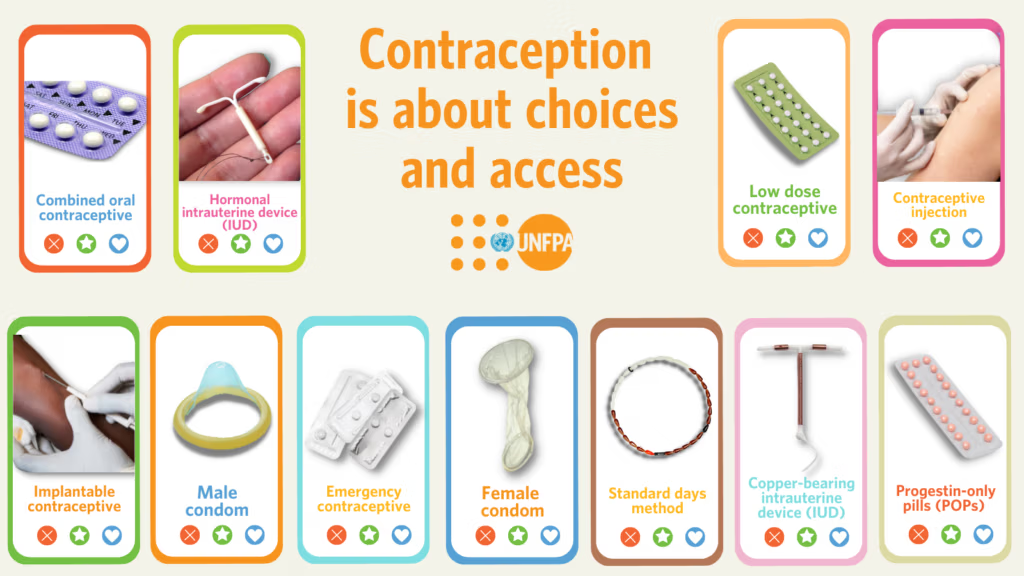
- Expansion of modern contraceptives from one method in 1970 to seven methods in 2024
2.3. Ending Gender Based Violence and harmful Practices:
- Increased legal and policy environment for gender equality and anti GBV
- Increased reporting on GBV
- Reduction of child marriage from 24% to 19%
- Strengthened monitoring and reporting of GBV
2.4. Prevention of Sexual transmission of HIV:
- New Infections declined from 17,000 in 2010 to 4,400 in 2023
- Sex workers prevention coverage increased from 6.3% in 2010 to 31% in 2023
- Adolescent and young women coverage from 26% in 2010 to 90% in 2023
2.5. Population and Development:
- Regular census and population-based surveys
- Increased deepening of disaggregated data
- Incremental application of evolving technology
- Strengthened integration of population dynamics to sustainable development
2.6 Adolescents and young people:
- Condom use in sexual intercourse by adolescents and young people aged 15-19 years increased from 53% females and 52.8% males in 2004 to 56.3% and 90.2% in 2020
- Unmet need for family planning for young people aged 15-19 declined from 35.5 in 2004 to 21.2% in 2024
- Increased Youth participation in SRH engagement
3. How we delivered our work
Advocacy & policy development: UNFPA has been advocating for the government to update and develop policies and legislation that address GBV and SRHR issues.
Capacity building: UNFPA and other development partners built the capacity of government to be able to deliver GBV and SRHR Services efficiently. For instance, training midwives on Emergency Obstetric Care to be able to avoid maternal deaths and CSE both in and out of school.
Health systems strengthening: Building the capacity of midwifery cadre, and adolescent friendly health centres to be able to save lives when bringing life to the world.
Data systems strengthening: UNFPA has supported census for the past five decades, DHS since 2004 up to date (2024 DHS).
4. The Unfinished Business
Unmet need for family planning: young people experience a disproportionately high unmet need for family planning, at 21.2%, exceeding the national average of 13%. This substantial gap in access to contraceptives significantly contributes to elevated rates of early and unintended pregnancies among young people, as well as unsafe abortions.
High incidences of HIV especially amongst young people: There are still high HIV new infections amongst young people which is of great concern and there is diminishing comprehensive knowledge of HIV to the same group.
High prevalence of Gender Based Violence including child marriages: 86% of women in Lesotho have suffered violence in their lifetime and 67% of that violence was perpetrated by an intimate partner making homes unsafe for women and girls. 19% of girls are married before 18 years.
High preventable Maternal Mortality: estimated at 566 per 100,000 live births (UN estimates) women in Lesotho still die of preventable causes despite widespread availability of antenatal care and skilled birth attendance. 36% of these deaths occur among women under the age of 24, with 8% under 20 years old and 28% between 20 and 24 years old.
Data gaps for SDG indicators particularly and SDG 3 and 5: The targets for SDG 3 and SDG 5 are still dragging behind and efforts should be accelerated to meet the targets by 2030. Lesotho’s reporting on just 47% of the Sustainable Development Goals highlights a serious shortfall in the availability of necessary data for effective reporting.
5. The Future – 2030 and Beyond
In collaboration with diverse partners, we envision a Lesotho where universal access to sexual and reproductive health rights is a reality. Achieving these ambitious goals demand a multi-pronged approach that tackles not only the systemic health challenges but also the deep-rooted socio-cultural barriers that impede progress.
UNFPA Envision a Lesotho:
- Where no one will die giving birth (Zero Preventable Maternal Mortality)
- Where all women will have a choice on when to have children, and how many children to have (Zero Unmet Need for Family Planning)
- Where women and girls will enjoy peace, dignity and safety in private and public spaces (Zero Gender Based Violence and harmful practices)
- Where children will be allowed to be children (Zero childbrides)
- Where future generations will be free from new HIV infections (Zero HIV and Sexual Infections)
- Where young people are fully empowered to realize their full potential
- Where real-time data defines our policy and management decisions